

Cogniterm to exhibit at Korea Police World Expo 2026 with an AI agent that turns case materials into 'AI-Ready Data'
The Big Data News, October 20, 2026 (summary of the Korean-language article)
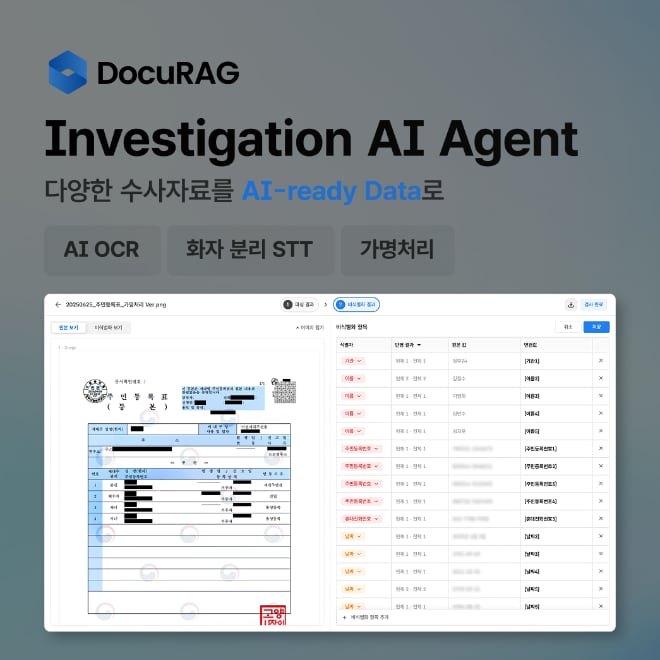
Documents converted to text with AI OCR, audio with speaker-separated STT
Personal and sensitive information detected and pseudonymized into ‘AI-Ready Data’ fit for AI analysis
DocuRAG module supply contract with the Korean National Police Agency
AI agent platform company Cogniterm will take part in Korea Police World Expo 2026, held at Songdo Convensia in Incheon from Wednesday, October 21 to Saturday, October 24. At a booth in the AI Startup Pavilion, Cogniterm will present the ‘DocuRAG Investigation AI Agent’, built for investigative work.
Case materials come in many forms, from paper and scans to handwritten statements and scene photos, which makes even digitizing them difficult. AI OCR recognizes documents, scans and images in different formats and turns them into electronic documents that keep their tables and layout. Interview audio is hard to search or analyze until it is transcribed, and mixed speakers make it hard to organize; speaker-separated STT transcribes audio and organizes the transcript by speaker.
Documents and recordings also contain personal and sensitive information such as names, resident registration numbers and phone numbers, so AI analysis often stalls over security. The agent detects and pseudonymizes personal and sensitive information in the converted text, turning it into ‘AI-Ready Data’ fit for AI analysis. The same person always gets the same pseudonym, so relationships within a case can still be analyzed after masking, and the organized data supports integrated case record search, summaries and timeline building.
Cogniterm said it has signed a contract to supply DocuRAG modules to the Korean National Police Agency. Among each module’s functions, it supplies DocuLLM’s AI OCR and DocuSafety’s detection and de-identification of personal and sensitive information. The deal is significant because the technology is being adopted by an investigative agency that must manage personal and sensitive information strictly.
DocuRAG, the platform behind the agent, lets organizations configure task-specific agents with less development effort, extending beyond investigation support to public work such as legal, finance, investigation and review; when work changes, agents can be added or modified without rebuilding the system. Both modules offer more than what is supplied here: DocuLLM also provides an in-house LLM specialized for work tasks, and DocuSafety also provides AI guardrails and security policy management and monitoring.
By integrating these AI DLP functions, DocuRAG helps organizations use generative AI while protecting personal and sensitive information. It supports on-premises and air-gapped environments and can connect to external AI models approved under an organization’s security policy. Cogniterm has built systems for the Ministry of Finance and Economy’s AI-ONE platform, the Tax Tribunal and the Korea Institute of Local Finance, and obtained CSAP SaaS Standard certification in June. Public institutions can adopt DocuRAG through the Public Procurement Service’s Digital Service Mall by choosing and combining the modules they need.
Co-hosted by Incheon Metropolitan City and the Korean National Police Agency, Korea Police World Expo is Korea’s only exhibition dedicated to the policing, security and safety industry. This year it features Physical AI & Robotics, Information Security and AI Startup pavilions, along with export consultations with overseas police and buyers and a conference on AI and public-sector cybersecurity.
Source: The Big Data News, reporter Sungmin Kim
Original article: Read the article (Korean)